
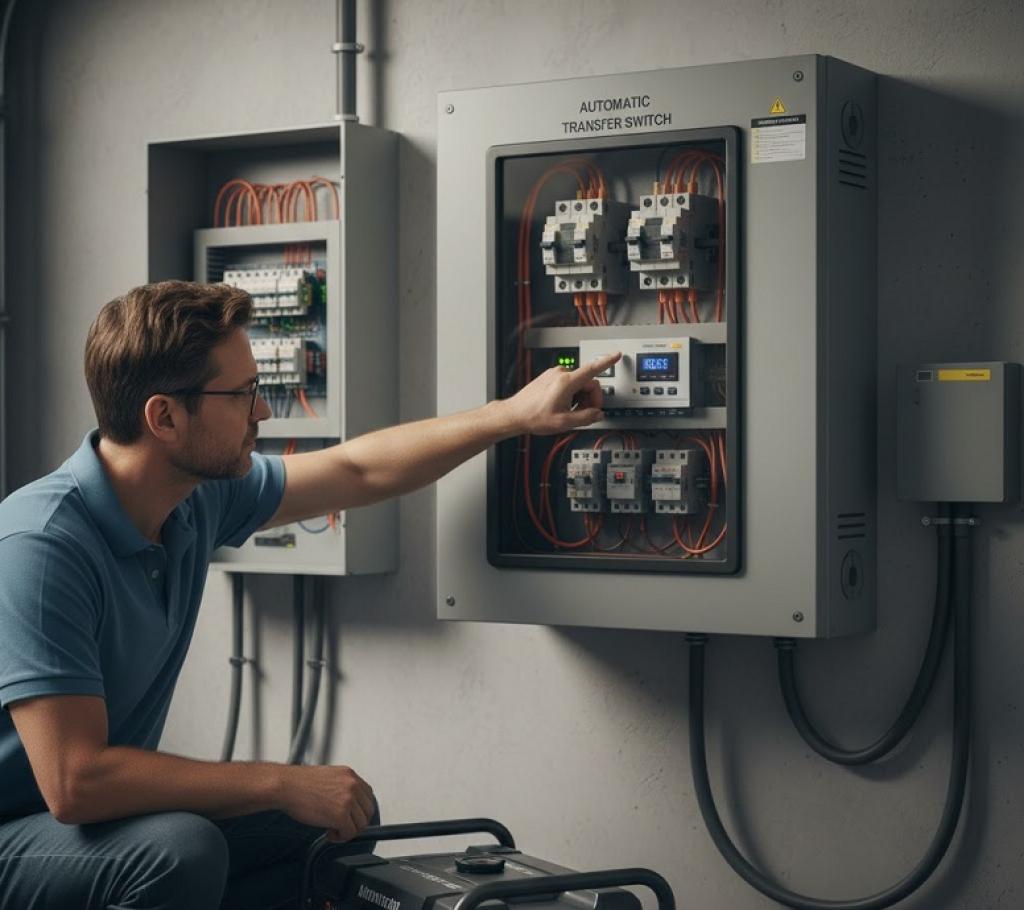
If you’ve ever wondered what is an automatic transfer switch, you’re likely exploring a standby generator or looking to make your home or business more resilient during outages. In simple terms, an ATS is the brains of your backup-power system. It senses a power loss, safely disconnects your building from the utility, and connects it to your generator—then switches you back when utility power is stable again. Below, the experts at JMR Electric Group break it down in plain English, so you know exactly what you’re buying and why it matters.
Quick Definition
An Automatic Transfer Switch (ATS) is an electrical device that monitors your normal (utility) power source and a backup source (typically a generator). When utility fails or falls outside safe voltage/frequency limits, the ATS:
- commands the generator to start,
- transfers the load from utility to generator once the generator is stable, and
- returns the load to utility and stops the generator when utility power is restored.
The ATS coordinates all of this automatically and—most importantly—prevents dangerous backfeeding into the grid.
Why the ATS Is Essential (and Not Optional)
- Safety: Interlocking prevents the utility and generator from energizing the same conductors at the same time. This protects utility workers and your equipment.
- Speed: The ATS detects a problem in seconds and initiates transfer—no fumbling with cords, breakers, or manual switches in the dark.
- Compliance: For permanently installed generators, most jurisdictions require a transfer switch that’s UL 1008–listed and installed to NEC (National Electrical Code) standards. (See the NEC—NFPA 70 overview for code context: NFPA 70 – National Electrical Code.)
How an Automatic Transfer Switch Works (Step by Step)
- Monitoring: The ATS continuously measures line voltage and frequency from the utility.
- Start Signal: If readings drift outside allowed ranges or power drops out entirely, the ATS sends a start command to the generator.
- Generator Warm-Up: The generator starts and stabilizes (voltage and frequency settle).
- Transfer: Once stable, motorized contacts inside the ATS open the utility source and close the generator source. Your building now runs on generator power.
- Return to Normal: When the ATS senses that utility power has returned and is within limits for a defined “retransfer” delay, it switches the load back and cools down the generator.
Most residential transfers happen in 10–30 seconds. Commercial systems can be tuned for process needs.
Main Components You’ll Find Inside an ATS
- Sensing & Control Board: The logic that monitors voltage/frequency and controls timing.
- Power Contacts/Mechanism: Electrically and mechanically interlocked contacts that select one source at a time.
- Neutral & Grounding Provisions: Depending on system design, you may have solid, switched, or overlapping neutrals.
- Service Disconnect (Optional): Service-entrance-rated ATS units include a main disconnect and proper bonding, reducing gear count and simplifying installations.
- User Interface: Status lights, display, and sometimes network connectivity for remote monitoring.
ATS Types and Transition Modes
Choosing the right type depends on what you’re powering and how sensitive it is.
- Open-Transition (Break-Before-Make):
- Brief, momentary power interruption during transfer (milliseconds to a second or two).
- Most common for homes and light commercial.
- Lowest cost and complexity.
- Closed-Transition (Make-Before-Break):
- Overlaps sources momentarily for a near-seamless transfer.
- Requires synchronization and utility approval.
- Used for critical loads where even a blip is an issue.
- Delayed or Programmed Transition:
- Intentionally inserts a short delay between opening one source and closing the other (helpful for motor loads).
- Reduces inrush and protects equipment.
- Soft-Load / Load-Add/Load-Shed Capable ATS:
- For mission-critical facilities, allows staged loading and integration with building management systems.
- Optimizes generator size and fuel use.
Sizing and Specifying the Right ATS
When JMR Electric Group designs or installs your backup system, we evaluate:
- Amperage & Voltage: Must match service size (e.g., 100A/200A residential; 400A+ commercial).
- Phase & Poles: Single-phase vs. three-phase; 2-, 3-, or 4-pole switching depending on neutral strategy.
- Service-Entrance Rating: If you want the ATS to double as your main, select a service-entrance-rated unit.
- Enclosure Rating: NEMA 1 (indoor), NEMA 3R (outdoor), or higher for harsh environments.
- UL 1008 Listing: Confirms the switch can withstand fault currents and perform its duty safely.
- Load Characteristics: Motor loads, HVAC, elevators, medical devices, and IT gear may require specific transition modes or coordination.
- Communication: Integration with generator controllers and remote monitoring apps if needed.
Installation Considerations You Shouldn’t Skip
- Permits & Inspections: An ATS is part of your electrical service. Expect permits and AHJ inspections.
- Location & Clearances: Mount where working clearances meet code. Consider noise, ventilation (for nearby generators), and flood risk.
- Grounding & Bonding: Critical for safety and to avoid nuisance behavior from sensitive electronics.
- Utility Coordination: For closed-transition and certain commercial setups, coordinate with the utility early.
- Labeling: Clear labeling for first responders and maintenance techs helps during emergencies.
Maintenance: “Install It and Forget It” Is a Myth
- Exercise the System: Most standby generators self-test weekly; ensure the ATS completes a transfer test periodically under supervision.
- Visual Inspection: Look for heat discoloration, loose terminations, moisture, or pest intrusion.
- Functional Testing: Verify start signals, transfer timing, and alarms.
- Recordkeeping: Keep logs; they’re invaluable for warranty support and troubleshooting.
Tip: Schedule an annual inspection with JMR Electric Group. We’ll test under load when appropriate and confirm your system still meets current code and site needs.
Common Mistakes to Avoid
- Using a non-listed switch or interlock for a permanent generator: It may fail inspection and jeopardize safety.
- Undersizing the ATS: If your service is 200A, a 100A ATS won’t cut it even if the generator is smaller.
- Ignoring neutrals and grounding: Switched vs. solid neutral choices have system-wide implications.
- Skipping ventilation/placement planning: Especially with outdoor gear and generator proximity.
- No load management plan: Large HVAC or well pumps may require staged start or soft-start strategies.
Do You Need an ATS at Home?
If you have—or plan to install—a permanently mounted standby generator, the practical answer is yes. Portable generators sometimes use manual transfer equipment, but for whole-home, hands-off reliability and safety, an ATS is the standard. It delivers uninterrupted comfort, keeps refrigeration and medical devices powered, and protects electronics during unstable utility conditions.
Cost Snapshot (What to Expect)
Prices vary with amperage, transition type, enclosure, and service rating. As a ballpark:
- Residential 100–200A open-transition, service-entrance rated: Equipment often runs in the low-to-mid thousands (USD), plus installation and permits.
- Commercial 200A–1200A+ or closed-transition: Higher equipment cost and more design/utility coordination.
A quick site visit from JMR Electric Group yields an accurate quote and the right specification the first time.
FAQs
Is an ATS the same as a whole-home surge protector?
No. Surge protection clamps voltage spikes; the ATS controls which source feeds your panel.
How long does transfer take?
Most residential systems transfer within 10–30 seconds from power loss to generator power.
Can I add an ATS to my existing generator?
Often yes. We verify compatibility, controls, and listing. In some cases, upgrading the generator controller or wiring harness is recommended.
Ready to Spec or Install an ATS?
A properly sized, code-compliant ATS is the difference between a safe, seamless outage and a risky DIY workaround. JMR Electric Group designs, installs, and maintains ATS solutions for homes and businesses—and we make the permitting and inspection process painless.
